
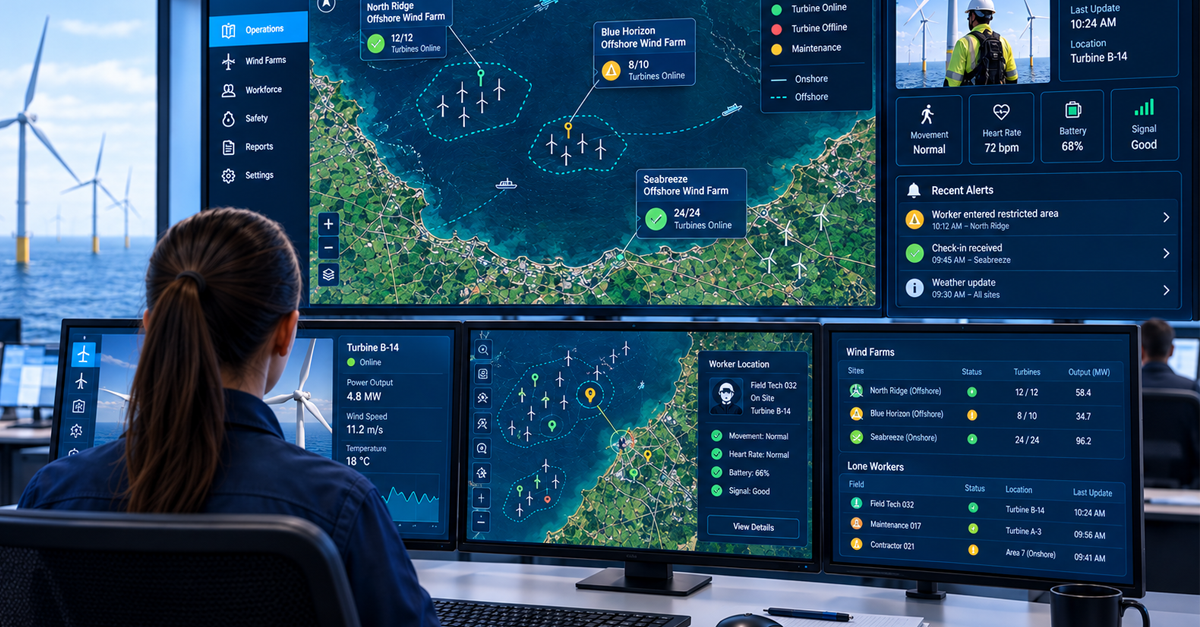

The renewable energy industry is expanding rapidly with wind and solar farms to battery storage facilities and emerging hydrogen projects — this means the number of people working in challenging, remote environments is also increasing.
A comprehensive lone worker safety campaign reduces operational risk, drives compliance, and protects your most valuable asset—your people working in isolation across remote renewable energy sites.
Building a Culture of Lone Worker Safety Across Remote Renewable Sites
Lone worker safety extends beyond regulatory checkboxes. Operations managers at renewable energy sites face the daily challenge of protecting personnel working in isolation across remote locations—turbine technicians conducting maintenance, contractors performing inspections, and site personnel responding to emergencies. The operational burden intensifies across wind, solar, battery, and hydro assets where workers operate miles from control rooms with limited connectivity and immediate support.
A structured lone worker safety programme establishes clear protocols, leverages proven technology, and creates accountability across your workforce. The campaign transforms safety from a compliance burden into an operational advantage that reduces incident rates, accelerates emergency response, and provides real-time visibility into personnel locations and activities. Organisations that implement comprehensive lone worker programmes demonstrate measurable improvements in response times, compliance rates, and worker confidence.
Effective campaigns address three critical operational challenges: real-time location tracking and check-in verification, automated alert systems for emergency response, and auditable records that demonstrate compliance with Health and Safety Executive requirements for lone worker protection.
Essential Components of an Effective Lone Worker Safety Programme
The strongest programme combines technology with established health and safety principles. Moving away from simply waiting for someone to say,“I need help.” to looking for signs that something may have gone wrong. Lone worker protection will be about anticipating risk, detecting abnormal situations, providing context and accelerating response.
Prevention
Identify hazards and reduce exposure through robust risk assessments, safe systems of work and appropriate training.
Communication
Give workers reliable ways to communicate and request assistance.
Detection
Use technology to identify potential incidents when workers cannot raise an alarm themselves.
Location
Know where assistance is needed.
Escalation
Ensure alerts reach the right people without unnecessary delays.
Response
Have clear procedures for assessing and responding to incidents.
Learning
Review incidents and near misses to continuously improve the system.
Technology can help in the following ways for scalable lone worker protection that integrates into your existing safety systems.
Deploy GPS-enabled safety features that provide real-time location snapshots and automated emergency alerts.
Control rooms gain immediate visibility into personnel locations, enabling rapid response when incidents occur. Mobile technology eliminates reliance on manual check-in calls and paper-based processes that create gaps in oversight. Personnel working across remote wind farms, solar installations, and hydro facilities maintain continuous connection to control centres regardless of phone reception or Wi-Fi availability.
Create accessible emergency response plans with live site documentation.
Provide lone workers with instant access to response procedures, site maps, and controller contact information through mobile devices. Ensure emergency plans include precise location data and up-to-date contact details for all site personnel. Safety systems should follow the worker as renewable energy workers are rarely confined to a single location. A technician might work at several sites during the same week. Contractors may move between projects. Engineers may travel to unfamiliar facilities to carry out specialist maintenance.
Automate compliance verification before site access.
Restrict site entry for personnel with incomplete or outdated training certifications. Induction processes ensure every lone worker receives site-specific safety briefings, understands emergency procedures, and confirms awareness of hazards before beginning work. Moving from reactive to proactive safety by aligning worker and site competencies to make sure workers are adequately trained and know what to expect before they get on site.
Establish scheduled check-in protocols with automated escalation procedures.
Configure systems to trigger alerts when workers fail to check in at predetermined intervals. Integrate weather monitoring to provide advance warnings of adverse conditions that increase lone worker risk.
The future isn't about giving workers a button to press. It's about building an intelligent safety net around them.